Sunday, May 4, 2014

Flavors of an imagined Dutch East Indies

I couldn't sleep.  There's a lot going on in my life right now that's put me into a contemplative mood lately.  News that my incredible Indonesian instructor was retiring got me thinking about my days as a graduate student in history at Northern Illinois University, where I studied trans-national cultural and policy connections of the late colonial period of the Netherlands East Indies, the modern nation of Indonesia.  Combined with my love of exploring the world of cocktails, this naturally made me consider ways to "continue my studies", so to speak, on a pleasant spring evening.  A little research, a trip to our incredible local liquor store, and the discovery of a gamelan orchestra station on my Roku later, and I was ready to explore a lost world of imagined, cross-cultural concoctions inspired by my earlier academic experiences.

I think the main reason why vintage and "vintage-style" cocktails have been so appealing to me, in a way that modern highballs and the "flavored vodka and juice" drinks can never really do, was the manners in which, by their design, they appeal on an intellectual level to my desire to learn about the historical peoples which created or inspired them.  The study, research of, development of and consumption of vintage cocktails transports me, through the senses, viscerally, to another time, another place, another world that exists only on paper or in the mind -- like the ways in which the academic pursuit used to do and still may, but in a way that academia has only begun, if at all, to explore.  The particular journey invoked by this 'blog post is particularly inspirational in that it is a sojourn into colonial worlds of exchange, understanding, misunderstanding, negotiation, translation, expropriation, conquest and independence -- worlds that not only no longer exist, but existed, if the ever existed at all, purely in the imagination -- either the imagination of those historical actors, or in my own.

The Holland House

I ordered this cocktail first off a truly incredible cocktail menu at a local steakhouse during our Fantasy Football awards banquet.  My buddy Arnie, who knows me all too well, called its taste "colonialism in a glass".  He's not wrong.


2 oz. jenever
1 oz. dry vermouth
1/2 oz. maraschino liqueur
1/2 oz. freshly squeezed lemon juice
Shaken over ice and garnished with a twist of lemon peel

I was under the impression that jenever was "Dutch gin", but I had no idea what that meant until now.  While it's reminiscent of gin, a spirit that gets the lion's share of its flavor from the addition of juniper berries prior to the final distillation, giving it a distinctly piney taste, the Peket de Houyeu Jenever I bought is quite substantially lighter than any other gin I've had, and, in fact, has a gently complex flavor and appearance that belies its having been aged briefly in oak.  

This is an impressive take on a typical martini, adding layers of nuance to a familiar cocktail. The sweetness of the maraschino helps balance the addition of a (for a typical martini) gargantuan quantity of vermouth, tempered by the addition of the lemon.  This is a well-balanced, more approachable and eminently less-imposing recipe.  I wouldn't mind trying the jenever in a traditional martini, either.

The Daisy

This was billed as the Dutch East Indies Daisy, which I find cumbersome and unnecessary.  (To a scholar of Dutch colonial history, the translation of Nederlands-Indie into English is ever-problematic.)  In any event, my Google search for "Cocktails from the Dutch East Indies" led me to this recipe.


3 oz. Batavia Arrack
1/2 oz. freshly squeezed lime juice
1/2 oz. Creme de Cacao
2 tbsps. fennel seeds
Two shakes of Angostura bitters
Shaken over ice and double-strained into a cocktail glass.

Arrack is an Indoneisan spirit, not dissimilar to rum.  It lacks the sophistication of that mass-produced, mass-marketed Caribbean distillate bound for the United States and to be inevitably united with Coca-Cola, though.  It's hotter, drier, and slightly rougher than rum, but the obvious underlying character that belies its common heritage as a sugar cane distillate.  I remember distinctly a disturbing, graduate school screening of Moeder Dao, de Schildpadgelikende ("Mother Dao, the Turtle-Like", a fanciful name for the Indonesian islands as an unchanging womb of wealth for the Dutch state and exoticism for the Dutch people) a modern producer's re-cut of early twentieth-century propaganda footage of the Dutch East Indies, seeing sugar cane being cultivated, by Javanese peasant workers in stupefyingly wretched conditions, and transformed into salable product for transport to Europe.  At that time I realized that the same forces present in the Caribbean labor->raw material->finished good economy must have also been present in the spice islands of Indonesia.  But tonight, in this cocktail, was the first time I was ever conscious of ever having tried the end product.  Even though arrack lacks the outward taste sensibilities of a culture familiar and comfortable with alcoholic consumption, with a bit of imagination, arrack is not an unpalatable mixer on its own. Combined with lime and a bit of chocolate and the earthy tones of fennel, it's similar to a Cuba Libre -- a cocktail itself borne of the imperial project.  Combining spices, citrus, and spirits present in the colonial context, it's not difficult to imagine this to be the drink du jure of a plantation owner or a Batavian bureaucratic functionary in the pre-World War II era.

The Dangerous Life

This cocktail was my creation, inspired by the "Saigon Correspondent", itself a modern take on an imagined, Vietnam War-era styled British colonial cocktail, the gin and tonic.  
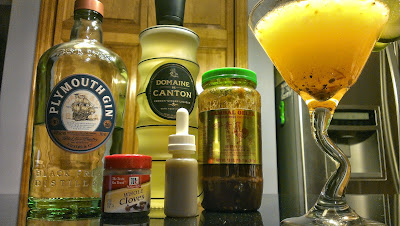


3 thick slices of cucumber, quartered, muddled with 1/2 oz. of freshly squeezed lime juice.
This, dry shaken with 3 oz. Plymouth gin and 1 oz. Domaine de Canton ginger liqueur, one bar-spoon of Sambal Oelek, fifteen drops of homemade lime bitters, and a tablespoon of whole cloves, and allowed to rest briefly, before being poured over ice, shaken, and served up with a wheel of cucumber and a wheel of lime.

The original recipe called for Plymouth gin and Domaine de Canton, a ginger liqueur based in cognac which is simply wonderful.  I kept these, along with the lime juice, muddled with cucumber.  I substituted the Sriracha with Sambal Oelek, a hot and flavorful Javanese-style pepper paste, and, since I wanted an "up" cocktail, swapped out the Q Tonic, which I detest, with a tablespoon of whole cloves, along with my own homemade lime bitters, to provide the herbal complexity missing with the loss of the tonic water.
When coming up with this recipe, I imagined the kinds of cocktails that the fictional Australian war correspondent in The Year of Living Dangerously, sent to Indonesia on the eve of the chaos and pervasive, unimaginable brutality of the euphemistically-termed "September 30th Movement", would have been gulping at the expat colony in Djakarta alongside his foreign counterparts with the BBC and the CIA.  In that, I wasn't disappointed.  It combines some uniquely Southeast Asian ingredients with some almost stereotypical "exotic" tropes, into a seamless taste experience -- both within, and without, the imperial "other".  It's a graduate thesis in a glass.


Much like my own academic studies into the history of the Netherlands East Indies, what I enjoyed most about all of these cocktails is how ethereal and disturbing they are.  The Holland House is undoubtedly the most conventional of the three, grounded in tradition but with a carefree air, reminiscent of what I imagine of the academic, optimistic and decidedly metropolitan tastes of late Empire.  The Daisy, of course, combines the flavors present in the decidedly rough spirit with some familiar and exotic flavors into a fantastic cocktail which, like the Aviation and the Twentieth Century conjure romantic and exotic images of movement in the Art Deco period, invokes the best intentions and sentimentality of the late Dutch imperial project in "Their Indies" -- with tastes both well-known and completely alien.  And, of course, what I've termed The Dangerous Life, the evil stepsister of these drinks, witness to the dark side of the Imperial project, the hot and almost seething flavors of unfulfilled promise ever-present behind the facade of a friendly and disarming smile of familiarity.  I'm almost shocked at how delicious these cocktails were; with some imagination, how intriguing the vision of the world they presented.  These cocktails are an intoxicating sensory glimpse at a complex world of Empire that is both, at once, stagnant, much deservedly gone forever, dynamic, and perpetually at work changing the world in which we live. 

Monday, February 17, 2014

The Kevin "Smush"

We wanted to call this a Kevin Smash, but he said something about "nomenclature" and "disappointed" and decided we needed to name it something else, so...


The Kevin "Smush"
  • 3/4 oz. bourbon
  • 3/4 oz. maraschino liqueur
  • 3/4 oz. Galliano
  • 3/4 oz. Malort
There's gotta be a better name for this.  I also made it with Tanqueray gin instead of the bourbon, and I think it's a little heavy on the maraschino since they were a little tough to tell apart.  I'm thinking an ounce of the base liquor, Galliano, and Malort each, with a real maraschino cherry, should do the trick.

Celebrating One Year of BLtB: The Scottish Wedding

My good friend Ted developed a wicked version of a martini that he called the "Scottish Wedding", utilizing gin, scotch, and Malört.  As he described it, it's got "pine and smoke, with bitterness to follow."  Like the marriage following a wedding.  Get it?  Anyway, I didn't have exactly the ingredients he described, so I came up with this one on my own.


The Scottish Wedding

  • 3 oz. Death's Door gin
  • 1.5 oz. Dewar's 12 year old Scotch
  • 1.5 oz. Jeppson's Malört
  • 2 dashes lemon bitters
  • Shake over ice, serve up, with a twist of lemon.
As you would expect, it's pretty devious and complex, and a worthwhile experiment in discerning what might be called "flavors of bitterness" ... smokey, piney, citrusy, medicinal, and others.  It's infinitely more interesting and surprisingly more palatable (to me) than a standard dry martini, although I don't expect these will catch on as well as martinis have.  Ted, I think you might be on to something here!

Friday, November 1, 2013

Autumn Leaves

The Autumn Leaves

  • 2 ounces rye whiskey.
  • 1/2 ounces orange liqueur
  • 2 dashes orange bitters
  • 2 dashes black walnut bitters
  • 1 bar spoonful maple syrup
  • Stir with ice for at least two minutes, and strain into a chilled cocktail glass
I used Jim Beam Rye.  I think as a general rule, if you make a drink with whiskey, you should use one you enjoy, and I enjoy Jim Beam Rye.  But I don't think there's any reason to bust out your Templeton for a drink that has sugary mixers.  Same goes for the orange liqueur.  You could use Cointreau but I just don't think there's any reason for it; I would have used our orange Curaçao but I found Triple Sec first.

The keys to this drink are the bitters, and the real maple syrup.  Real maple syrup is incredible, tastes almost nothing like Mrs. Buttersworth on pancakes, and is really expensive.  So get a small bottle and use it for recipes like this.  Black walnut bitters are also incredible, and impart a nice nuttiness to anything like coffee.  This is the only cocktail I've found that uses black walnut bitters but I'm going to try to find more because this cocktail is fantastic.  It tastes just like fall.  I wonder how it would work with a cinnamon stick garnish.

Saturday, August 17, 2013

The New Englander

Probably not all that surprisingly, when I'm traveling I enjoy taking in the local tastes; when we were on Cape Cod last year, I found myself some Moxie, which purports to be an example of an early soft drink.  It's a bit like a cola, but a bit like Dr. Pepper in that it seems to be made with a whole bunch of botanicals and herbs that give it a spicy, bitter character not dissimilar to Jägermeister.

I came home with a two-liter of it, but didn't want to drink it as I don't have a reliable supply.  That is, until my brother and sister-in-law visited her grandma a couple weeks ago in Chatham, and brought me back a half case of the stuff.  Jackpot!  It's time to try a Moxie cocktail!  With that, I present...


The New Englander
  • Ice in rocks glass.
  • Add 1.5oz. gin (I used Plymouth.  It just seemed the right thing to do.)
  • Top with Moxie.
  • Float a dash or two of Worcestershire sauce.
I often think that New Englanders and Chicagoans are kindred spirits.  Our propensity to engage in quixotic fan behavior for long-unsuccessful sports teams is one reason. Our mutual distaste for and borderline obsession with New York City is another.  But I think the most important similarity is that we wear our mutual sufferings of some truly terrible winter weather like a badge of honor.  That's this drink.  It's a whirlwind of flavors in a glass that would make a lesser breed cringe.  It's vegetal and sweet, but not enough to overpower the bitterness, which isn't strong enough to counteract the savoriness.  It's a strange drink, for a strange people.  I'm proud to think I'm the right kind of strange.

Tuesday, July 9, 2013

Plymouth Gin and the Vesper Martini

I have been by no means a connoisseur of martinis, and it's not the gin.  A gin and tonics was my very, very first mixed drink I had ever had, when I had just turned 21 down in Champaign-Urbana and was hanging out with Toby, Richard and Jacqueline, transfer students from the University of Sheffield, England, who accurately (to my limited palate at the time) described a gin and tonic as described as "drinking Christmas".  So I was pretty well used to the unusual juniper quality of gin pretty early in my "career".  I also learned pretty quickly that every gin is a little different, and that, for my taste, I preferred, for instance, Tanqueray to Bombay and the like in a gin and tonic.  The G&T remained my "go-to" cocktail for a number of years, but, to be honest, even despite becoming increasingly interested in expanding my palate for cocktails, the venerable martini never really piqued my interest.

I can't say I'm more or less likely to try more of them now, but having developed a serious taste for vintage cocktails lately, I was delighted when Kelly returned from a trip to Binny's with some St. Germain, Pimm's No. 1, and a bottle of Plymouth Gin.  Having never tried Plymouth, I decided the best way would be to throw myself into the deep end -- mixing it into a martini.  But not just any martini; I also wanted to try my hand at making perhaps one of the most famous martinis, the Vesper.


The Vesper

  • To ice in shaker, add
  • 3 oz. gin (I used Plymouth Gin),
  • 1 oz. vodka (I used Smirnoff 80),
  • ½ oz. Lillet Blanc,
  • Shake until cold and strain into chilled cocktail glass,
  • Express with lemon peel, and garnish.
This is a classic James Bond martini, first ordered by the main character in the Ian Fleming classic Casino Royale but with different, now unattainable ingredients.  You can't get, for instance, real Kina Lillet anymore.  (Kina, derived from the French word for "quinine", I suppose used to be quite substantially bitter than our Lillet Blanc, which is still a concoction of French wines and citrus liqueurs which has made its way into a surprising number of my recipes lately, but which lacks the quinine which might have given Mr. Bond's drink a bit more complexity than mine.)  Gordon's, the brand of gin specified by Mr. Bond, is actually a top shelf distillate in Great Britain but is a much maligned facsimile here, more on par with "rail" gin.  So in order to make a Vesper, one has to be forgiving of oneself, while attempting to pay homage to the spirit of the cocktail. 

And what a cocktail it is.  As my introduction into Plymouth Gin, I am impressed.  It is certainly the cleanest and simplest gin I think I've had, unencumbered as seems to be with a large number of citrus botanicals that seem to be in vogue at present.  It's hard to tell where the gin stops and the vodka begins, it's so smooth.  That's not to say it has no flavor, though; juniper is present, as is a very gentle citrusy character.  When combined with the Lillet and the lemon, the hints of citrus and dryness are peeled back and there's a really subtle but identifiable peppery finish right at the tip of the tongue.  

I don't know if the Vesper converted me to martinis, but I know that Plymouth is going to remain in my stable for a long time.

Monday, July 8, 2013

Adventures in Whiskey Drinks

Saturday, Kelly and I were doing some experimenting in obscure whiskey drinks.  My friend Wyl has recently decided to give whiskey another go, so I wanted to see if a number of distinguishably different  whiskies could be used in ways that would nuance and understate, rather than amplify and highlight, those highly distinguishable profiles.  The results are below:


The Leatherneck
  • Ice in shaker,
  • 2 oz. blended Canadian whisky (I used Canadian Club),
  • ¾ oz. blue Curaçao (I used DeKuyper's),
  • ½ oz. freshly squeezed lime juice,
  • Shake into chilled cocktail glass,
  • Garnish with lime wheel.
The photo doesn't even do this drink justice.  The Leatherneck is a gorgeous teal color, and tasted surprisingly light.  (Probably was the use of blended Canadian whiskey, which I find to be not as complex as American rye whiskeys or even Bourbons.)


The Fred Collins
  • Ice in shaker,
  • 2 oz. Bourbon whiskey (I used Four Roses "yellow label"),
  • ½ oz. simple syrup (I had to make this.  I put about a shots-worth of water in the microwave for two minutes, then added several heaping tablespoons of sugar to the mixture and stirred until it dissolved.  I don't know if this is necessary, to be honest.)
  • Juice of one lemon, freshly squeezed, 
  • One splash Cointreau
  • 6 oz. lemonade (re: the simple syrup above.  See what I mean?)
This recipe made way, way too much for even two drinks, but, once again, for a whiskey drink, it was surprisingly tart and refreshing.  The Bourbon's oakiness shined through, though, lending a complexity to this drink that would have been altogether different, if not lost entirely, if a fruity or citrusy gin (or, goodness forbid, vodka) had been used.


The Scofflaw
  • Ice in shaker,
  • 1½ oz. rye whiskey (I used Bulleit rye),
  • 1 oz. dry vermouth (I used Martini & Rossi Extra Dry Vermouth),
  • ¾ oz. freshly squeezed lemon juice,
  • ¾ oz. pomegranate grenadine (I didn't have this, so i used Rose's "nuclear red" grenadine.  This may have been a mistake),
  • Shake into iced cocktail glass.
A great drink with a great name, I decided to really punch it up to the max with Bulleit, my spiciest rye, but it remained refreshing and tasty without it becoming overpowering.

All in all, before Saturday I thought whiskeys should be constrained to cocktails where their most potent flavor profiles would be on display (old fashioneds, Manhattans, Sazeracs, and the like).  But as these experiments show, whiskeys can stand up on their own in a number of fashions, lending their characteristics in a number of ways that don't need to be on display to be delicious.  I'm impressed.